
MTL vs RDL Vaping: How to Choose Pod and Coil Resistance
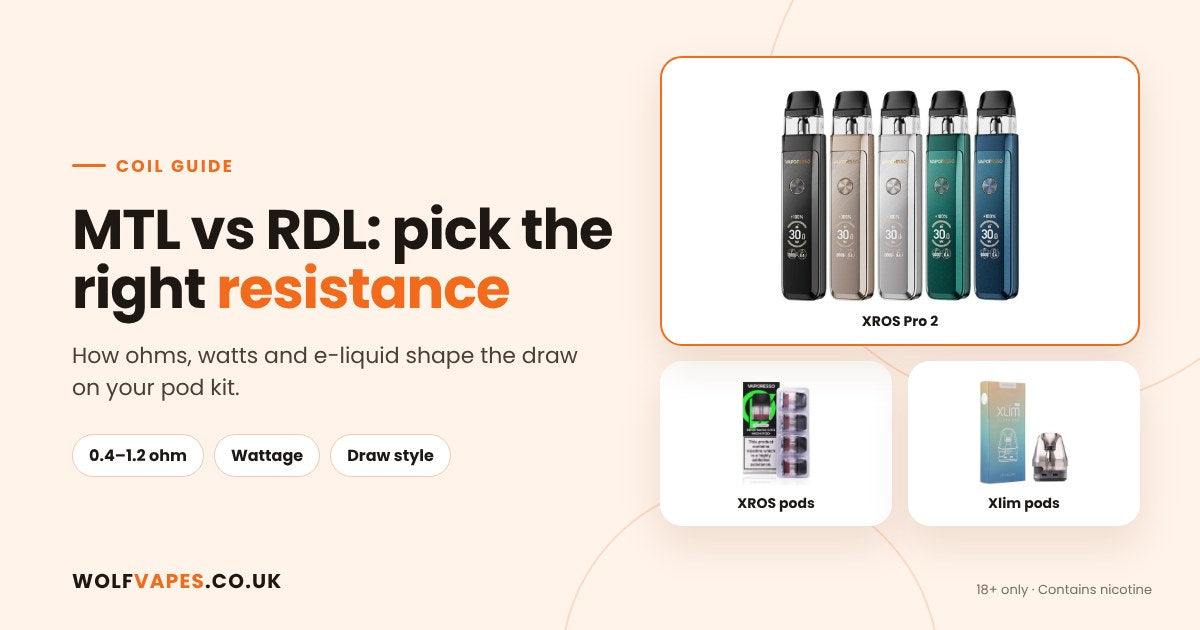
MTL (mouth-to-lung) vaping means drawing vapour into your mouth first and then inhaling it, much like a cigarette, using a tight airflow and a higher-resistance coil of roughly 0.8 to 1.2 ohms. RDL (restricted direct lung) means inhaling straight into the lungs through a looser, but still slightly restricted, airflow, usually with a lower-resistance coil of around 0.4 to 0.6 ohms. Choosing the right style, and the right pod resistance to match it, is the single biggest factor in whether a pod kit feels right to you.
This guide explains how the two styles differ, what coil resistance actually does, how to match resistance to wattage and e-liquid, and which resistance to pick for common pods such as the Vaporesso XROS and OXVA Xlim ranges. It is written for adults who already vape and want to understand their options.
Quick Answer
For a tight, cigarette-style draw, choose MTL with a 0.8–1.2 ohm pod and a nic salt or 50/50 e-liquid. For a looser, airier draw with more vapour, choose RDL with a 0.4–0.6 ohm pod and a lower nicotine strength.
- Higher resistance (1.0–1.2 ohm): tighter draw, lower power, longer battery life, suits 20mg nic salts.
- Middle resistance (0.8 ohm): a common all-rounder for MTL.
- Lower resistance (0.4–0.6 ohm): looser draw, more power and vapour, suits RDL and lower nicotine strengths.
- Always stay within the wattage range printed on the pod or its packaging.
What is MTL vaping?
Mouth-to-lung vaping is a two-step draw. You pull vapour into your mouth, pause briefly, and then inhale into your lungs. The airflow is tight, so it takes a little effort to draw, and the vapour volume is relatively small.
Most pod kits and almost all prefilled pod kits are designed for MTL. Because the vapour volume is small, MTL pairs well with higher nicotine strengths, which is why 10mg and 20mg nic salts are so common in MTL pods. If you have used a prefilled kit such as the Hayati Pro Max Plus or IVG Pro range, you have already been vaping MTL.
Who tends to prefer MTL?
- Adults who like a draw similar to a cigarette.
- Anyone using 10mg–20mg nic salts.
- People who want discreet vapour and long battery life.
What is RDL vaping?
Restricted direct lung sits between MTL and full direct-to-lung (DTL) vaping. You inhale straight into your lungs in one breath, as you would with a deep breath of air, but the airflow still has some resistance, so it is not as open as a sub-ohm tank.
RDL produces more vapour per puff than MTL, so most people use a lower nicotine strength with it. Many refillable pod kits, such as models in the Vaporesso XROS and OXVA Xlim families, can be set up for either MTL or RDL by changing the pod resistance and opening the airflow.
Who tends to prefer RDL?
- Adults who find MTL too tight and want a smoother, airier draw.
- People who prefer bigger flavour and more vapour.
- Vapers using freebase e-liquids or lower-strength nic salts.
MTL vs RDL vs DTL at a glance
| Feature | MTL | RDL | DTL |
|---|---|---|---|
| How you inhale | Mouth first, then lungs | Straight to lungs, slightly restricted | Straight to lungs, open airflow |
| Typical pod or coil resistance | 0.8–1.2 ohm | 0.4–0.6 ohm | Below 0.4 ohm (usually tanks) |
| Typical power | Around 10–18W | Around 20–30W | Higher, often 40W+ |
| Vapour volume | Small | Medium | Large |
| Common e-liquid | Nic salts, 50/50 | 50/50, freebase, lower-strength salts | High-VG shortfills |
| Typical nicotine strength | 10–20mg | Lower than MTL | Low, often 3–6mg |
| Battery use | Lowest | Moderate | Highest |
These are typical ranges rather than fixed rules. The wattage and resistance printed on your pod always take priority over a general table.
What does coil resistance actually do?
Resistance, measured in ohms (Ω), describes how much the coil resists the flow of electricity. On a pod kit, it decides how much power the coil draws and how hot it runs.
- Higher resistance (1.0–1.2Ω) draws less power. The coil heats more gently, produces less vapour and uses less battery. The airflow on these pods is usually tight.
- Lower resistance (0.4–0.6Ω) draws more power. The coil heats more, produces more vapour and uses more battery. The airflow is usually looser to match.
On a fixed-output device, the battery voltage and the coil resistance together set the power, following the basic electrical relationship power = voltage² ÷ resistance. In practice, this is why fitting a lower-resistance pod to the same device gives a warmer, bigger hit. Many modern pod kits read the pod's resistance automatically and set the power to suit it, while others let you adjust the wattage yourself.
Mesh vs standard coils
Most current pods use mesh coils, which spread heat over a wider surface. Mesh coils tend to heat evenly and are now standard across the XROS and Xlim pod ranges. You will still choose a resistance; the mesh design simply affects how the heat is distributed.
How to match resistance and wattage
Every pod has a recommended power range. Running below it can give weak vapour, while running above it can cause burnt hits, leaks or a shorter coil life. The table below shows typical recommendations listed by UK retailers for two popular refillable pod ranges. Check your own pod packaging, as versions differ.
| Pod resistance | Vaporesso XROS pods (typical) | OXVA Xlim V3 pods (typical) | Best suited to |
|---|---|---|---|
| 1.2Ω | About 10W | 10–12W | Tight MTL, 20mg nic salts |
| 1.0Ω | About 12W | Not listed for V3 | MTL |
| 0.8Ω | About 16W | 12–18W | MTL all-rounder |
| 0.6Ω | About 21W | 20–25W | Loose MTL or RDL |
| 0.4Ω | About 30W | 26–30W | RDL, higher-power devices only |
The lowest-resistance pods need a device that can supply enough power. For XROS pods, UK retailers note that the 0.4Ω version is intended for the higher-power XROS models rather than every device in the family, so check your kit's manual before buying. Both Vaporesso XROS replacement pods and OXVA Xlim pods are listed with a choice of resistances.
Matching e-liquid and nicotine strength to your style
The right e-liquid makes as much difference as the right pod. Two things matter: the VG/PG ratio and the nicotine strength.
VG/PG ratio
PG (propylene glycol) is thinner and wicks easily into small MTL coils. VG (vegetable glycerin) is thicker and produces more vapour. Higher-resistance MTL pods work best with thinner liquids such as 50/50 or nic salts, while lower-resistance RDL pods can cope with slightly thicker liquids. Very thick, high-VG shortfills are generally designed for DTL tanks and can struggle to wick in small pod coils.
Nicotine strength
Because RDL produces more vapour per puff, the same nicotine strength feels stronger than it does in MTL. As a general guide, many adults use 10mg–20mg nic salts for MTL and step down to a lower strength when moving to RDL. UK law caps nicotine-containing e-liquid at 20mg/ml. Our bar-style nic salts compared guide covers the popular 10ml options.
Choosing the right resistance for your pod kit
If you are coming from a prefilled kit
Prefilled pod kits are almost always MTL with 20mg nic salt. To get a similar feel from a refillable kit, start with a 0.8Ω or 1.0Ω pod and a 20mg nic salt, with the airflow mostly closed. Our refillable vs prefilled pod kits guide explains the cost side of switching.
If MTL feels too tight
Move to a 0.6Ω pod, open the airflow a little and consider a lower nicotine strength. This gives a looser draw without going fully RDL.
If you want RDL
Use a 0.4Ω or 0.6Ω pod on a device that supports the higher power, with a lower-strength e-liquid. Kits such as the Vaporesso XROS Pro 2 and OXVA Xlim Pro 2 offer adjustable power. Our XROS comparison and OXVA pod kits compared guides list the power range of each model.
If battery life matters most
Stick with 1.0Ω or 1.2Ω pods. They draw the least power, so the battery lasts longer between charges.
Common mistakes to avoid
- Running a pod above its wattage range: this is a common cause of burnt hits and shortened coil life.
- Using thick e-liquid in a tight MTL pod: the coil may not wick fast enough, causing dry hits.
- Keeping 20mg nic salt when switching to RDL: the larger vapour volume can make it feel much stronger than expected.
- Not priming a new pod: after filling, leave the pod for a few minutes so the coil soaks before the first puff.
- Assuming every pod fits every device: pods are only compatible within their own family, and even then some resistances suit only certain models.
If a pod is leaking, gurgling or tasting burnt, our pod kit troubleshooting guide walks through the likely causes.
UK rules worth knowing
- Pods and tanks for nicotine-containing e-liquid are limited to 2ml in the UK, and refill bottles to 10ml, under the e-cigarette regulations.
- Nicotine strength is capped at 20mg/ml.
- Since 29 October 2026, the sale of all vaping products to under-18s is illegal, including nicotine-free products, under the Tobacco and Vapes Act 2026.
- Since 1 October 2026, Vaping Products Duty of £2.20 per 10ml applies to all vaping liquids, whatever your vaping style.
- Worn-out pods and old devices should go to electrical recycling, never in household bins.
Frequently Asked Questions
What does MTL mean in vaping?
MTL stands for mouth-to-lung. You draw vapour into your mouth first and then inhale it into your lungs, similar to smoking a cigarette. MTL uses a tight airflow and higher-resistance coils, typically 0.8 to 1.2 ohms.
What does RDL mean in vaping?
RDL stands for restricted direct lung. You inhale vapour straight into your lungs in one breath, but the airflow is still slightly restricted. It usually uses pods of around 0.4 to 0.6 ohms and produces more vapour than MTL.
Is 0.8 ohm MTL or RDL?
A 0.8 ohm pod is usually treated as MTL. It sits in the middle of the MTL range, giving a balance between flavour, vapour and battery life, and it is a common starting point for nic salts.
Is 0.6 ohm good for nic salts?
It can be, but 0.6 ohm produces more vapour than higher-resistance pods, so 20mg nic salt may feel strong. Many adults use a lower strength at 0.6 ohm. Check that your device supports the recommended wattage.
What wattage should I use for a 1.2 ohm pod?
Typically around 10 to 12 watts, based on retailer listings for XROS and Xlim pods. Always follow the range printed on your pod's packaging, as it can vary between versions.
Can I use RDL pods with 20mg nic salt?
You can, but most people find it too strong because RDL produces more vapour per puff. If you move from MTL to RDL, consider stepping down your nicotine strength.
Does lower resistance drain the battery faster?
Yes. Lower-resistance pods draw more power, so the battery runs down faster than with higher-resistance pods on the same device.
Do all XROS pods fit all XROS devices?
XROS pods are designed for the XROS family, but UK retailers note that the 0.4 ohm pod is intended only for the higher-power models. Check your device manual before choosing a resistance.
Is RDL the same as sub-ohm vaping?
Not quite. Sub-ohm usually describes coils below 1 ohm used for open direct-lung vaping with tanks. RDL uses a restricted airflow on a pod or small tank, so it sits between MTL and full direct-lung vaping.
Final Verdict
MTL and RDL are not better or worse than each other; they suit different preferences. If you like a tight, cigarette-style draw and use 10mg–20mg nic salts, an MTL pod of 0.8 to 1.2 ohms is the natural choice, with the higher end giving longer battery life. If MTL feels restrictive and you prefer more vapour, an RDL setup with a 0.4 or 0.6 ohm pod and a lower nicotine strength is worth trying, provided your device supports the higher power.
Whichever you choose, stay within the wattage printed on the pod and match your e-liquid to the coil. If you are unsure, a 0.8 ohm pod is a sensible middle ground to start from.
This product contains nicotine, which is a highly addictive substance. For adults aged 18 and over only.
-
Posted in
Buying Guide, Coils, OXVA Xlim, Pod Kits, Refillable Pods, Vaporesso XROS